Fourth Grade Camo School Patchwork PNG: Avoid These Design Pitfalls Before You Print
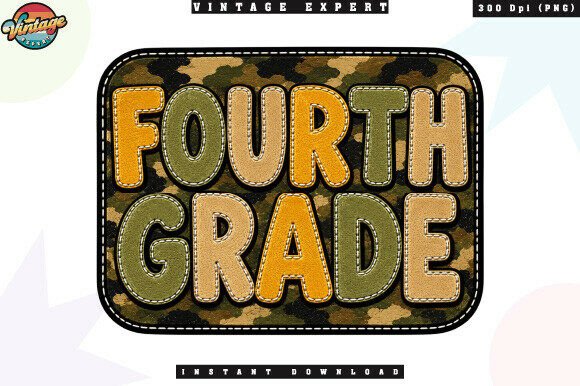
If you are looking to create a standout design for back-to-school apparel, the Fourth Grade Camo School Patchwork PNG offers a unique aesthetic that blends rugged texture with academic pride. This high-quality digital file features camouflage patchwork lettering with faux embroidery and stitched fabric textures, all wrapped in a faux leather patch style. It is an excellent choice for teachers, students, and small business owners who want to move beyond generic clipart. However, simply downloading the file does not guarantee a professional result. Many creators make critical errors when applying textured designs like this, leading to blurry prints or designs that look out of place on specific fabrics.
To ensure your project succeeds, it is essential to understand the technical specifications and the creative limitations of this asset. By anticipating common pitfalls, you can leverage the 4500px by 5400px resolution effectively without wasting time or money on reprints. Let's explore what makes this design special and how to use it correctly across various platforms.
Understanding the Texture and Style
The primary appeal of the Fourth Grade Camo School Patchwork PNG lies in its visual depth. Unlike flat vector graphics, this image simulates a physical patch with stitching details and fabric grain. This "faux embroidery" effect adds a tactile quality that appeals to parents and students alike. When applied to t-shirts, mugs, or stickers, it suggests durability and craftsmanship. However, this stylistic choice requires careful handling during the design process.
Common Mistake: Many beginners treat textured PNGs as if they were simple solid shapes. They often resize the image too aggressively or place it over busy backgrounds that clash with the camouflage pattern. Because the design relies on contrast to show off the stitching and leather texture, placing it on a similarly patterned shirt can make the text unreadable. The result is a muddy design where the "patch" disappears into the background.
Better Approach: Always preview your design on a mockup before finalizing the order. Since the background of the PNG is transparent, you have the freedom to place it anywhere, but you must choose a base color that complements the camo tones. Solid colors like navy blue, olive green, black, or white typically allow the patchwork details to pop. If you are using sublimation on polyester, ensure the base fabric color doesn't interfere with the light and dark shades within the camouflage pattern.
Technical Specifications Matter More Than You Think
The product details specify a massive resolution of 4500px by 5400px at 300 DPI. This is a significant advantage for large-format printing, but it can also lead to confusion if you are working in software designed for web-only graphics. A file of this size contains immense detail, which is perfect for printing on large tote bags or framing work caps. However, trying to use this full-resolution file directly in a low-end graphic editor without proper optimization can slow down your workflow unnecessarily.
What to Check: Before purchasing or downloading, verify that your printing method supports high-resolution files. While 300 DPI is ideal for commercial printing, some heat press machines or cutting plotters may require specific file formats. Ensure your RIP software (Raster Image Processor) can handle the pixel dimensions without upscaling or distorting the image.
Another frequent error involves the assumption that a transparent background means the design will blend perfectly with any surface. Transparency removes the white box around the image, but it does not adjust the lighting or shadows of the design to match the new environment. If you place a shadow-heavy faux leather patch on a glossy mug, the reflection might make the "stitched" edges look unnatural.
Navigating Commercial Use and Licensing
One of the most attractive features of this download is the permission for commercial use. This allows entrepreneurs to sell products featuring the Fourth Grade Camo School Patchwork PNG on Print on Demand (POD) platforms like Etsy, Redbubble, or Amazon Merch. Whether you are creating teacher appreciation shirts, student class tees, or classroom decorations, the license covers these applications. However, the terms of use contain strict boundaries that, if ignored, could lead to account suspensions or legal issues.
Crucial Warning: Resale or redistribution of the digital file itself is strictly prohibited. You cannot upload the raw PNG to a stock photo site, sell it as a standalone download, or share it in a zip folder with other designers. The license applies only to the end product created using the file. For example, selling a t-shirt with the design is allowed; selling the t-shirt design file (the .png or .eps) is not.
Additionally, be aware that while the file is ready for instant download, there is no physical product included. If you are expecting a pre-made shirt or a printed sticker to arrive in the mail, this is not the right product for you. This is a digital asset intended for you to integrate into your own production workflow. Failing to distinguish between a digital template and a physical good can lead to frustration and wasted time waiting for a shipment that never arrives.
Color Accuracy and Material Variations
Even with a high-quality 300 DPI file, the final output depends heavily on your equipment and materials. The product notes explicitly state that colors may appear slightly different due to monitor settings and print quality. This is particularly relevant for the camouflage elements, which rely on subtle shifts in tone to create the illusion of depth.
The Reality Check: A screen displaying RGB colors will always look different from a printer outputting CMYK or a dye-sublimation transfer. If your monitor is not calibrated, the greens in the camo pattern might look neon on your screen but dull gray-green on the final shirt. To avoid dissatisfaction, always request a proof from your printer or order a single sample before launching a bulk run of Fourth Grade Camo School Patchwork PNG products.
This discrepancy is not a defect in the file but a limitation of the medium. Professional designers account for this by testing their designs on actual materials. If you are printing on mugs, remember that the curvature of the object can distort the "patch" shape. You may need to adjust the perspective or scale of the image to ensure the stitching looks straight and natural when wrapped around a cylinder.
Maximizing Value for Your Projects
Whether you are a hobbyist crafting a gift for a fourth-grade teacher or a small business owner scaling your POD store, the versatility of this file is unmatched. It works seamlessly on t-shirts, tumblers, stickers, greeting cards, pillows, and even book covers. The key to success lies in treating the design as a premium element rather than a generic decoration.
Practical Tips for Success:
- Layering: Don't just slap the patch on the chest. Consider adding complementary text or smaller icons around the main design to create a cohesive layout. However, ensure the added elements do not compete with the detailed stitching of the camo patch.
- Placement: For large items like tote bags, center the design. For smaller items like stickers or mug wraps, ensure the 4500px width is scaled appropriately so the pixels remain sharp. Never stretch the image to fit a non-standard shape, as this will blur the faux leather texture.
- File Management: Keep a backup of your original 300 DPI file. Do not edit the downloaded version repeatedly; instead, work on copies to preserve the integrity of the high-resolution data.
By respecting the technical limits and understanding the licensing terms, you can create professional-grade products that stand out in a crowded market. The Fourth Grade Camo School Patchwork PNG is more than just a graphic; it is a tool for storytelling. When used correctly, it conveys a sense of fun, durability, and school spirit that resonates with both educators and students.
Take the time to evaluate your current setup, check your color profiles, and adhere to the usage guidelines. Doing so ensures that your investment in this high-quality digital file translates into tangible, successful projects. From classroom crafts to commercial merchandise, the potential is vast, provided you approach the design with care and attention to detail.